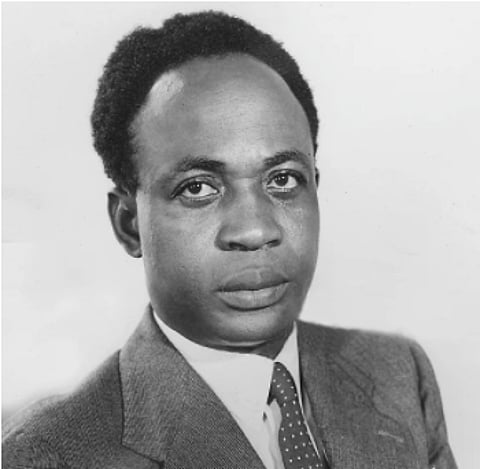


Kwame Nkrumah was a political leader from Ghana who played a key role in the country's independence from British colonial rule in the mid-20th century. He served as Ghana's first prime minister and later as its first president, leading the country from 1957 until 1966.
Nkrumah was born in 1909 in the village of Nkroful, located in what is now the Western Region of Ghana. He received his early education in the local mission schools and later attended college in the United States and the United Kingdom.
After completing his education, Nkrumah returned to Ghana in 1947 and became involved in the country's political movement for independence. He quickly rose to prominence as a leader of the movement, and in 1951 he founded the Convention People's Party (CPP) to push for independence.
Nkrumah's leadership and the CPP's organizing efforts ultimately led to Ghana's independence in 1957. After independence, Nkrumah became the country's first prime minister and later its first president.
As president, Nkrumah implemented a number of ambitious development plans aimed at modernizing and transforming Ghana into a industrialized nation. He also sought to spread the ideals of pan-Africanism, the belief that all African nations should unite to achieve common goals.
Despite his successes, Nkrumah's government was criticized for its authoritarian tendencies and for its lack of democratic institutions. Additionally, his economic policies led to widespread economic difficulties, and in 1966, a military coup ousted Nkrumah from power.
After his overthrow, Nkrumah lived in exile in Guinea, where he died in 1972. Despite his controversial legacy, Nkrumah remains an important figure in Ghana's history and is celebrated as a hero by many Ghanaians for his role in leading the country to independence.
Kwame Nkrumah was a charismatic leader and a powerful orator who played a key role in Ghana's path to independence. He was a strong advocate of pan-Africanism and his leadership and efforts led to the country's independence from British colonial rule.
However, his government faced criticisms for its lack of democratic institutions, authoritarian tendencies and economic policies which led to widespread economic difficulties. Nevertheless, his legacy is still remembered and celebrated by many Ghanaians as a hero for his role in leading the country to independence.
