
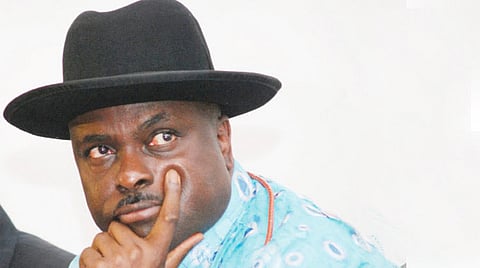
Ex Governor James Ibori Faces £101.5M Confiscation Order in the UK
The United Kingdom is seeking to confiscate £101.5 million (approximately N110 billion) from James Ibori, a former state governor convicted of abusing his office to amass wealth and laundering millions in Britain and other countries. A court order issued in London on Friday aims to recover the ill-gotten funds from Ibori, shedding light on his complicated legal and political history.
Ibori's early encounters with the law in Britain date back to the 1990s when he resided in London with his wife, Theresa Ibori. During that time, he worked as a shop assistant at a home improvements chain store, Wickes. However, legal trouble found him as he and his wife were arrested and convicted of theft and fined for attempting to steal goods from the store. Additionally, Ibori faced a conviction for possessing stolen goods after being caught with someone else's American Express card at London's Euston train station.
Despite these early convictions, Ibori's political rise in Nigeria commenced in the late 1990s when he formed a close friendship with Major Hamza al-Mustapha, Chief Security Officer to General Sani Abacha, the military dictator of Nigeria at the time. This connection proved beneficial for Ibori, propelling him forward in both politics and business. In 1999, as Nigeria transitioned to democracy after Abacha's death, Ibori was elected governor of Delta State, one of Nigeria's major oil-producing regions. He served two consecutive four-year terms, stepping down in May 2007.
However, from 2005, Ibori came under investigation by Nigeria's Economic and Financial Crimes Commission (EFCC) and London's Metropolitan Police for corruption-related allegations. The investigators discovered properties secretly owned by Ibori in Britain, South Africa, and the United States, as well as evidence of his extravagant lifestyle, including hefty monthly expenses on luxury hotels, shopping, restaurants, and nightclubs.
A significant turn in the investigation came when the then EFCC Chairman, Nuhu Ribadu, accused Ibori of attempting to bribe him with $15 million in cash in April 2007 to halt the investigation. Ribadu claimed to have deposited the cash at the Central Bank of Nigeria instead of accepting the bribe. Ibori denied the allegation in statements to Nigerian media but refused to be cross-examined in a British court, while Ribadu testified under oath, and the British judge accepted his evidence as true.
In 2010, Ibori fled Nigeria for Dubai, and the UK requested his extradition. He was flown to London in 2011 and subsequently imprisoned after pleading guilty to ten charges of fraud and money laundering at London's Southwark Crown Court in 2012. Ibori's sentencing to 13 years in jail was seen as a landmark victory in the fight against corruption, though it also exposed criticisms of Nigeria's judicial system.
Ibori was released in December 2016, having served half of his sentence before and after conviction. He returned to Nigeria in early 2017, where he was welcomed by cheering supporters in Delta State.
Following Ibori's guilty plea and conviction, British prosecutors initiated efforts to confiscate his assets in 2013. However, this process faced delays due to parallel legal actions and lengthy court proceedings launched by Ibori and several co-defendants who had served jail time for their involvement in his money laundering. Despite these appeals, the British Court of Appeal judges ultimately upheld the convictions in 2018, leading to the recent order seeking the confiscation of £101.5 million from Ibori's illicit wealth.
