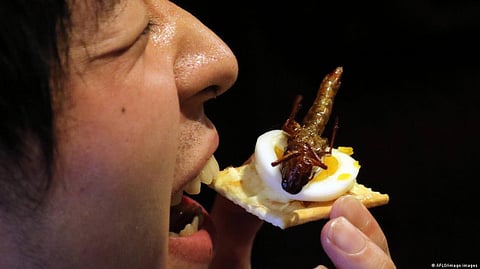


House crickets and smaller mealworms' maggot-like larvae, a species of shiny black beetle, will be the third and fourth insects that can be marketed as food to consumers in the European Union. Eight more requests are awaiting approval.
The sale of the larvae in powder, frozen, paste, and dried form was approved by the EU on Tuesday. You can sell the powdered, partially-defatted crickets.
For many Europeans, the thought of eating creatures that wriggle or crawl in any form isn't exactly appealing. But insects, already a delicacy in high-end restaurants around the world, are a normal and healthy part of diets in countries like Mexico and Thailand. They have also captured the attention of scientists and businesses looking to clean up farming and feed the planet's growing population.
Cutting meat emissions a 'huge challenge'
Meat and dairy make up the majority of the planet-warming food pollution, which contributes to around one-quarter of global warming. Methane is a potent but short-lived greenhouse gas that is exhaled by cows and sheep, and farmers clear forests to develop meadows and cultivate soy, which is fed to animals in proportions of three-quarters.
Fried crickets and mealworm salads might replace some steaks and hamburgers, which would help slow down climate change and prevent species extinction.
"It's such a huge challenge to deal with the rising demand for livestock products," said Tim Searchinger, technical director of the food program at the World Resources Institute, a US environmental research organization. "We pretty much have to pursue every avenue of solution."
Although it claimed that eating insects "contributes positively to the environment, health, and livelihoods," the European Commission's approval of two new insects as foods does not seem to be part of a campaign to shift diets.
Instead, the new regulations make it clear that house crickets and smaller mealworm larvae are OK to eat for people without allergies. Additionally, they have decided that meals containing them ought to be labeled.
"Nobody will be forced to eat insects," the European Commission said in a tweet last week.
Even so, the action might hasten the transition to diets that are less harmful to the environment. Around half of the population in Germany, for example, expects to eat less meat, whereas in the US, people are eating more meat but switching from beef to less-polluting meats like chicken. Particularly in processed goods, insect protein may offer a less expensive option.
Protein makes up between 35 and 60 percent of the dry weight of insects. The range's lower end is higher than the majority of plant-based protein sources, while the range's upper end is higher than meat and eggs. When it comes to converting the calories in their meal into body calories, insects outperform cows. They also multiply quickly and put on weight quickly.
Only a few researchers have attempted to calculate the environmental harm caused by eating insects. According to a 2021 life cycle assessment, obtaining the same quantity of protein from yellow mealworms requires 70% less land and emits 23% fewer greenhouse gases than obtaining it from broiler chicken.
In previous investigations, it was also discovered that while plants are worse for the environment than meat, insects are better.
