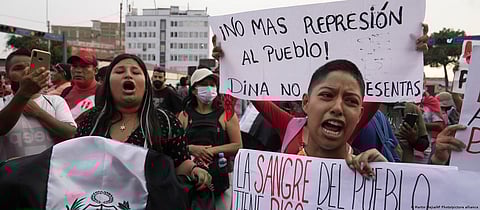


On Wednesday, Peruvian lawmakers submitted a motion to oust President Dina Boluarte from her position. The action is being taken while protests, which have caused food and fuel prices to skyrocket, continue unabatedly.
The resolution, which was supported by 28 communist congressmen, was signed by previous leftist president Pedro Castillo, and Reuters news agency claimed to have reviewed a copy of it.
A minimum of 26 signatures were required to file the motion.
Before the proposal can be debated in Congress, where it needs to garner support from two-thirds of the chamber, it must now be approved by 52 votes.
There have been demands for fresh elections since President Boluarte took power.
The president blamed political polarization during Castillo's tenure, as well as drug traffickers and others, for the violence on the streets.
"I am not going to surrender to authoritarian groups that want to impose solutions that are not part of our constitutional order or the democratic tradition," Boluarte said recently.
On Tuesday, Boluarte called for a "national truce" to end the crisis.
According to Peru's Ombudsman Office, since the anti-government protests started last month, at least 47 people have died and hundreds have been injured.
Following Castillo's removal and incarceration immediately after his effort to dissolve Congress, the protests started in early December.
In an effort to get the situation under control, the authorities declared a state of emergency.
Numerous barriers that prevented freight from reaching the southern part of the country also contributed to a lack of basic goods and increased fuel and food prices.
The blockades also led to a shortage of liquified petroleum gas (LPG), which is used most frequently in Peru for houses and vehicles.
One of the nearly 7,000 affected cab drivers, Alexander Cornejo, told a local radio station, "I've already been told there's no more LPG in Arequipa."
In Puno, which has seen some of the worst violence since December 7, the cost of basic goods like potatoes and tomatoes has tripled.
"The cost of fruits and vegetables has increased. Everything has gotten bigger, so I believe the supply cars should be allowed to pass. In Puno, Jacqueline Flores spoke with the AFP news agency.
Peru still has 85 roadblocks, according to the transportation ministry on Wednesday.
Luis Otsuka, Governor of the Madre de Dios region, warned that if the roadblocks continued, he would have to look to Brazil and Bolivia for food and gasoline.
