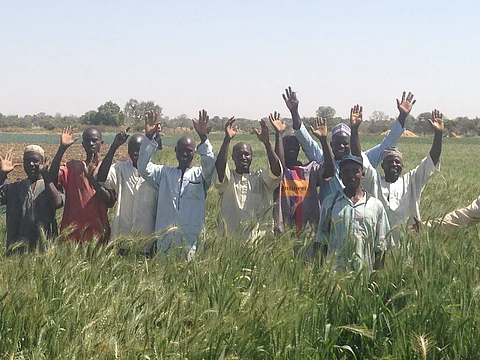


This was announced by the Minister of Agriculture and Food Security, Senator Abubakar Kyari, during the launch of the 2023/2024 dry season farming initiative under the National Agricultural Growth Scheme and Agro-pocket Project in Kadume Village, Hadejia Local Government Area, Jigawa State.
Minister Kyari explained that the federal government support will yield over 1.2 million tonnes of wheat during the upcoming farming session, which is a crucial component of the National Agricultural Growth Scheme and AgroPocket Project, facilitated by a $134 million loan from the African Development Bank (AfDB).
He stated, “The dry season farming is an integral part of the National Agricultural Growth Scheme and AgroPocket Project, made possible by a $134 million loan facility advanced to Nigeria by the African Development Bank (AfDB).”
According to him, the present administration under the leadership of President Bola Tinubu, had resolved to expand the capacity of farmers to engage in the cultivation of key staples like rice, maize, cassava and wheat, across the country.
“The aim is to increase crop yield by at least 20 per cent compared to the previous year. These high-value staples will be joined by others like soybeans and sorghum in the wet season.
“Other selected staples are earmarked for similar, varied support, all aimed at significantly reducing food inflation, as well as Nigeria’s dependence on foreign import while increasing domestic consumption,” the minister said.
This he said, will ultimately promote agricultural self-sufficiency and stimulate economic growth pointing out that the government is committed to ensuring that the support gets to the farmers.
“The programme will be technology-enabled, thus guaranteeing transparency and accountability in the provision of the subsidy and other support services like extension, insurance and additional finance.
He gave the assurance that farmers would be given improved seeds which are heat-tolerant wheat varieties like Borlaug 100; and Attila among others in addition to investing in irrigation infrastructure projects to optimize water usage and mitigate the challenges posed by the dry season.
